
5 Common Laboratory Procurement Mistakes and How to Avoid Them

Laboratory procurement mistakes can have far-reaching consequences for laboratory operations. From unnecessary spending and workflow disruptions to compliance risks and unreliable results, poor procurement decisions often create challenges that could have been prevented.

Understanding the most common laboratory procurement mistakes can help laboratories improve efficiency, maintain quality standards, and ensure uninterrupted operations.

Here are five procurement mistakes laboratories should avoid and practical ways to address them.

Laboratory Procurement Mistake #1: Prioritising Price Over Total Cost of Ownership

One of the most common procurement mistakes is selecting products based solely on the lowest purchase price. While this may seem cost-effective initially, the cheapest option often becomes the most expensive over time.

For example, an instrument with a lower upfront cost may require frequent maintenance, expensive replacement parts, or prolonged downtime due to poor technical support. Similarly, low-cost reagents or consumables may have shorter shelf lives or inconsistent performance that affects laboratory productivity.

How to Avoid It

Instead of focusing only on purchase price, evaluate the total cost of ownership. Consider factors such as:

  • Maintenance and servicing requirements
  • Availability and cost of consumables
  • Technical support and training
  • Equipment lifespan
  • Downtime risks
  • Warranty coverage

A slightly higher initial investment can often result in significant savings and improved reliability over the long term.

Laboratory Procurement Mistake #2: Skipping Vendor Qualification

Choosing suppliers without proper evaluation can expose laboratories to serious risks. Products may arrive damaged, fail quality specifications, or lack the documentation required for regulated environments.

For laboratories operating under accreditation standards, sourcing from unqualified vendors can also create compliance concerns during audits and inspections.

How to Avoid It

Develop a structured vendor qualification process before engaging new suppliers. This process should include:

  • Verification of regulatory certifications
  • Review of quality management systems
  • Assessment of product documentation
  • Evaluation of delivery performance and reliability
  • Reference checks where applicable

Working with qualified and reputable suppliers helps ensure consistent quality and supply continuity.

Laboratory Procurement Mistake #3: Reactive Rather Than Planned Purchasing

Many laboratories wait until inventory levels become critically low before placing orders. This reactive approach often results in emergency purchases, higher shipping costs, workflow disruptions, and delayed testing activities.

Supply chain challenges, import delays, and unexpected demand increases can quickly turn a minor inventory issue into a major operational problem.

How to Avoid It

Implement proactive inventory management practices, including:

  • Establishing minimum stock levels
  • Conducting regular inventory reviews
  • Monitoring usage trends
  • Forecasting future demand
  • Accounting for supplier lead times

A well-planned procurement strategy helps laboratories maintain uninterrupted operations while reducing unnecessary costs.

Laboratory Procurement Mistake #4: Ignoring Regulatory and Accreditation Requirements

Laboratories operating in regulated environments must ensure that all procured products meet relevant standards and quality requirements. Purchasing equipment, reagents, or consumables without verifying compliance can jeopardise accreditation status and compromise the validity of test results.

In some cases, non-compliant products can also create safety risks and expose organisations to regulatory penalties.

How to Avoid It

Incorporate compliance verification into every procurement decision. Before approving purchases, confirm that products meet applicable requirements such as:

  • ISO standards
  • NAFDAC regulations
  • Manufacturer certifications
  • Accreditation requirements
  • Industry-specific guidelines

Maintaining a procurement compliance checklist can help ensure that quality and regulatory considerations are never overlooked.

Laboratory Procurement Mistake #5: Failing to Consolidate Suppliers

Managing numerous suppliers for similar product categories can create unnecessary complexity. Procurement teams often spend more time processing orders, managing relationships, and resolving inconsistencies than necessary.

In addition, fragmented purchasing reduces purchasing power and makes it more difficult to negotiate favourable pricing and service agreements.

How to Avoid It

Review supplier relationships regularly and identify opportunities for consolidation. Partnering with a smaller number of qualified suppliers can provide several advantages:

  • Improved pricing and contract terms
  • Consistent product quality
  • Simplified procurement processes
  • Better communication and support
  • Greater supply chain reliability

Strategic supplier partnerships often deliver long-term operational and financial benefits.

Building a Smarter Procurement Strategy

Laboratory procurement is far more than a purchasing function. It is a strategic process that directly influences quality, efficiency, compliance, and operational continuity.

By avoiding these common mistakes and adopting a more structured approach, laboratories can reduce risk, improve performance, and make better use of available resources.

At Katchey, we understand that effective procurement is foundational to laboratory excellence. As a trusted partner to laboratories across Nigeria, we provide access to quality laboratory equipment, diagnostics products, consumables, and technical expertise that help organisations maintain reliable operations and achieve their objectives with confidence.


DNA Testing in Agriculture with Katchey

Katchey’s Role in DNA Testing for Agriculture

DNA testing in agriculture is transforming the way Nigerian farmers grow crops, breed livestock, and meet international standards. At the forefront of this shift is Katchey Laboratories, a trusted partner providing molecular testing services, high-quality lab equipment, and expert support. With Katchey, farmers can rely on science-backed decisions to boost productivity and profits.

At the heart of this transformation in Nigeria is The Katchey Group a trusted provider of scientific testing, equipment, and support services. Katchey is helping Nigerian farmers embrace the power of DNA to improve productivity, quality, and profitability. Explore our offerings.

DNA Testing in Agriculture

DNA Testing for Seeds: Start Strong with the Right Genetics

Poor seed quality and mislabeled varieties remain major challenges for Nigerian farmers. These issues often result in low yields, unpredictable traits, and significant financial losses.

To combat this, Katchey offers DNA testing services that verify seed identity and purity before planting. Thanks to DNA testing in agriculture, farmers can:

  • Confirm specific seed varieties (such as maize, rice, or tomatoes)
  • Detect contamination or mislabeling early
  • Select high-performing genetics tailored to their environment

Armed with this information, farmers can plant confidently, knowing their decisions are backed by accurate science. Learn more about our laboratory services.

GMO & Export Testing: Supporting Compliance Through Science

For agribusinesses targeting export markets, DNA testing in agriculture ensures regulatory compliance and product traceability. Many countries require rigorous checks such as:

  • GMO testing for labeling and certification
  • Species identification to confirm product origin
  • Detailed traceability for global safety standards

Through globally recognized molecular testing, Katchey Laboratories provides timely, accredited results. These support international trade, helping Nigerian farmers and food producers gain access to new markets and maintain trust with foreign buyers.

Katchey’s End-to-End Agricultural Support

Unlike others, Katchey doesn’t stop at testing. We also equip, train, and guide farmers and institutions. Whether you run a small farm, a research project, or a large-scale operation, Katchey provides:

  • ✅ Accredited molecular testing in advanced labs
  • ✅ Access to top-tier equipment like real-time PCR systems and extraction kits
  • ✅ Expert consultation and technical training for agricultural ventures
  • ✅ Vendor-managed inventory (VMI) systems for smooth lab supply management

Additionally, as Nigeria’s premium distributor for Thermo Fisher Scientific, Katchey ensures you receive world-class solutions with localized support.

Why DNA Testing Matters Now More Than Ever

Today’s farmers face challenges such as food insecurity, climate change, and strict trade regulations. In this context, DNA testing in agriculture offers a smart, science-based path forward. It allows for:

  • Better crop and livestock performance
  • Early disease detection and mitigation
  • More efficient resource use
  • Increased competitiveness in international markets

By partnering with Katchey, Nigerian farmers can adopt cutting-edge technology with confidence and ease—improving both yields and sustainability.

Partner with Katchey for DNA-Driven Agricultural Success

Whether you’re sowing seeds, managing livestock, or preparing goods for export, Katchey Laboratories is your go-to partner for DNA testing in agriculture. Let’s work together to build a smarter, safer, and more profitable future for Nigerian farming.

Need Assistance?
For inquiries or further assistance, reach out to Katchey:
📧 Email: info@katchey.com
📞 Phone: +2349090904420, +2349058639672
🌐 Website: www.katchey.com

Stay Connected with Katchey

Balancing Cost & Quality in Lab Consumables | Katchey

How to Balance Cost and Quality When Buying Laboratory Consumables

Introduction

In laboratory operations, balancing cost and quality in lab consumables is essential for ensuring accurate test results, compliance with industry standards, and overall efficiency. However, many Quality Assurance (QA) Managers face the challenge of balancing cost and quality when purchasing laboratory consumables. While cost-saving is important, opting for low-quality products can lead to contamination, inaccurate results, and compliance risks.

At Katchey Company Limited, we understand the importance of high-quality laboratory consumables and equipment at competitive prices. Our commitment to quality ensures that laboratories can achieve optimal performance without compromising compliance or reliability.

Lab Consumables

1. Define Quality Requirements Upfront

The first step in balancing cost and quality is clearly defining the necessary quality standards for your lab operations. To do this effectively, consider the following factors:

  • Regulatory Compliance: Ensure consumables meet industry standards such as ISO, SON, etc.
  • Material Composition: Verify the purity, sterility, and chemical compatibility of consumables.
  • Lot-to-Lot Consistency: Reliable suppliers like Katchey Company Limited provide batch certifications and quality control assurances.

By establishing these requirements from the start, you can avoid purchasing low-quality consumables that may compromise your results.

2. Conduct a Cost-Benefit Analysis

At first glance, choosing the cheapest consumables may seem like a cost-effective decision. However, this can lead to increased expenses in the long run due to rework, contamination, and instrument damage. To make an informed decision, conduct a thorough cost-benefit analysis by considering:

  • Total Cost of Ownership (TCO): Factor in storage, waste disposal, and replacement costs.
  • Supplier Reliability: Dependable suppliers like Katchey ensure timely delivery and product availability, reducing downtime.
  • After-Sales Support: Katchey provides technical support and consultation, ensuring you get the best value for your purchase.

As a result, a well-rounded analysis will help you choose consumables that provide both affordability and quality.

3. Choose a Trusted Supplier with Strong Industry Credentials

One of the most effective ways to ensure quality while managing costs is by partnering with a supplier that prioritizes high standards. A trusted supplier like Katchey Company Limited offers:

  • A reputation for delivering premium-quality products from globally recognized manufacturers.
  • Certifications that align with international regulatory standards.
  • A commitment to quality assurance through rigorous testing and validation.

By choosing the right supplier, you can be confident in the quality and consistency of your laboratory consumables.

4. Test Samples Before Bulk Purchasing

Before committing to a large order, QA Managers should request and evaluate product samples. Katchey offers sample testing opportunities, allowing you to:

  • Assess product performance, sterility, and compatibility with your lab processes.
  • Compare quality between multiple options to make an informed decision.
  • Ensure that consumables meet your lab’s specific requirements.

5. Optimize Procurement Strategies

Quality consumables

To get the best value for your investment, consider strategic purchasing approaches:

  • Bulk Purchasing for High-Usage Items: Katchey offers competitive pricing and discounts on bulk orders.
  • Vendor-Managed Inventory (VMI): Reduce waste and stock shortages by allowing Katchey to manage your inventory needs.
  • Regular Supplier Evaluation: Ensure consistent quality by reviewing supplier performance regularly.

6. Invest in Sustainable and Cost-Effective Alternatives

Sustainability is becoming increasingly important in laboratories. Katchey provides eco-friendly consumables, helping labs reduce waste and lower long-term costs. Benefits of sustainable products include:

  • Reduced environmental impact and disposal costs.
  • Reusable options that maintain compliance while saving money.
  • Energy-efficient equipment that optimizes resource usage.

Conclusion

Balancing cost and quality in laboratory consumables procurement requires a strategic approach. By working with a trusted supplier like Katchey Company Limited, you can ensure that your laboratory gets high-quality products at competitive prices while maintaining compliance and efficiency.

Need expert guidance on lab consumables? Contact Katchey now for premium-quality solutions tailored to your needs.

Understanding Certification Standards: What Every Lab Should Know

In the ever-evolving world of science and technology, certification standards are the cornerstone of trust, credibility, and excellence for laboratories. These standards ensure that labs operate at the highest levels of quality, producing reliable results that meet global expectations. This article will explore the importance of certification standards, their role in building trust, and how Katchey Laboratories Limited leads the way as an ANAB-accredited and ISO-certified lab.

Why Certification Standards Matter

Certification standards are vital for laboratories because they:

  • Ensure Reliability: Certified labs demonstrate their ability to deliver consistent and accurate results. Furthermore, they instill confidence in stakeholders.
  • Build Trust: Clients, regulators, and stakeholders rely on certified labs for unbiased and dependable data. Therefore, obtaining certification is critical.
  • Enable Global Collaboration: Certification fosters cross-border partnerships by ensuring uniformity in processes and results. As a result, labs can engage in more collaborative opportunities.
  • Drive Internal Improvement: The certification process promotes continuous enhancement of lab operations and staff competence. Consequently, labs experience long-term growth and operational efficiency.

Thus, adopting these standards is not only beneficial but also necessary for labs seeking to excel in a competitive environment.

ISO Certification: The Gold Standard for Laboratories

ISO certifications, particularly ISO/IEC 17025, are globally recognized benchmarks for testing and calibration laboratories. This standard specifies the requirements for a lab’s competence to carry out tests and calibrations, including:

  • The use of validated methods and equipment.
  • A robust Quality Management System (QMS).
  • Technical competence of staff, which enhances credibility and accuracy.

By achieving ISO certification, a lab demonstrates its commitment to producing reliable and defensible results that meet international standards. Consequently, this fosters trust among clients and stakeholders, further enhancing the lab’s reputation.

ANAB Accreditation: A Mark of Excellence

The ANSI National Accreditation Board (ANAB) is one of the world’s leading accreditation bodies. ANAB accreditation signifies that a lab operates in compliance with stringent international standards. For clients and stakeholders, this is a powerful assurance of the lab’s credibility and competence.

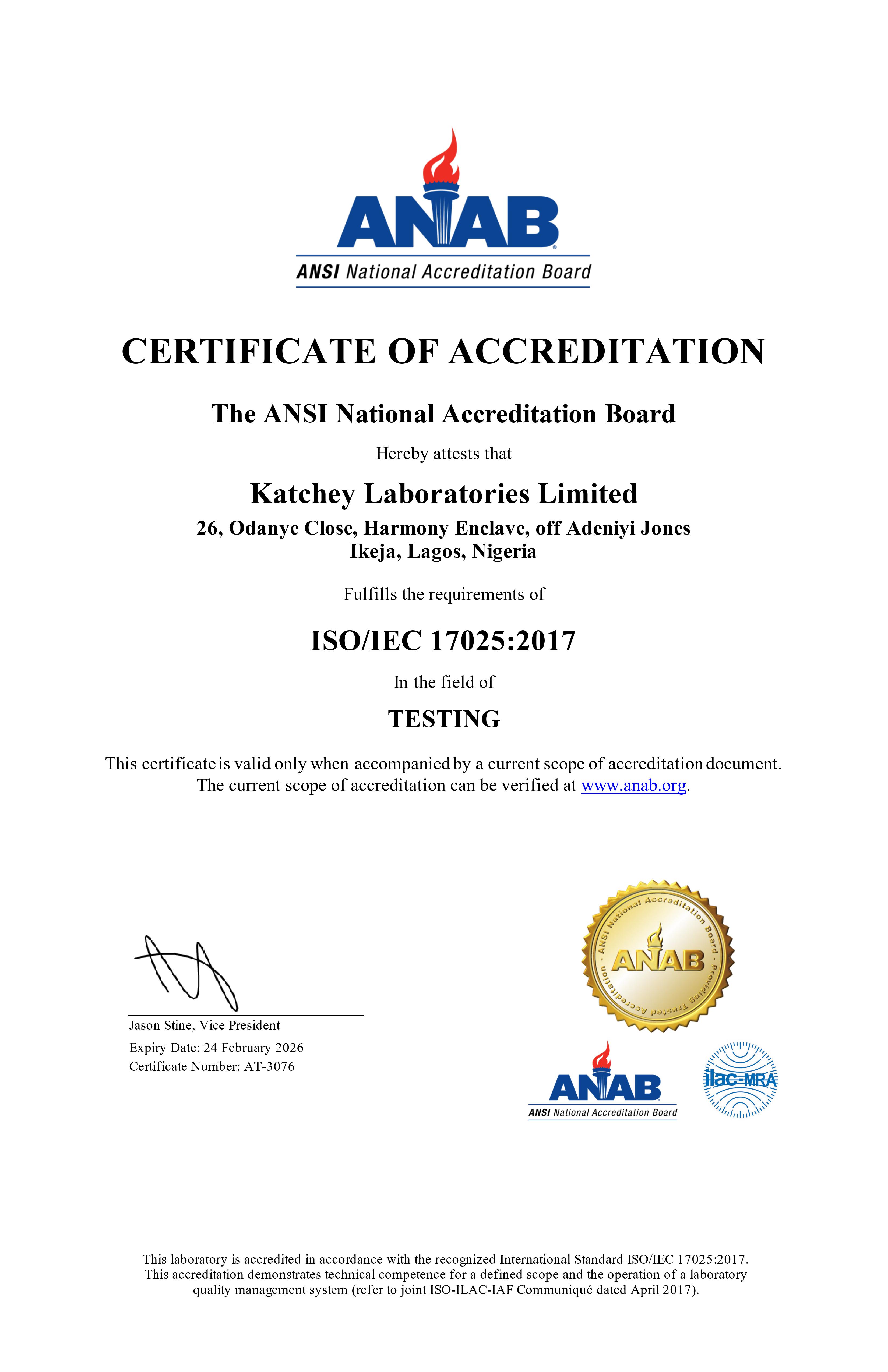
At Katchey Laboratories, ANAB accreditation underscores our dedication to delivering excellence. It reflects our adherence to rigorous standards and our commitment to supporting industries with trustworthy testing and certification services. Moreover, this accreditation positions us as a reliable partner in fostering global trade and innovation.

Katchey Laboratories Limited: Certified for Your Confidence

Katchey Laboratories Limited is proud to be both ANAB-accredited and ISO-certified. These credentials solidify our position as Africa’s leading independent analytical laboratory complex. Our certifications:

  • Guarantee accurate and reliable results for our clients.
  • Enhance our ability to support global trade by ensuring compliance with international standards.
  • Showcase our commitment to quality, sustainability, and innovation.

As a result, whether it’s food safety, pharmaceutical testing, or product certification, our clients trust us to deliver results that inspire confidence.

Benefits of Certification for Your Lab

If you’re considering certification for your lab, here are some key benefits:

  • Enhanced Reputation: Certified labs attract more clients and partnerships.
  • Regulatory Compliance: Certification ensures adherence to industry regulations and standards.
  • Operational Excellence: The certification process improves workflows, reduces errors, and optimizes resource use.
  • Competitive Advantage: Accredited labs stand out in a crowded market, offering added value to their clients.

Thus, pursuing certification is a strategic move that can elevate your lab’s status and operational efficiency.

Steps to Achieve Certification

Achieving certification may seem daunting, but with the right approach, it’s attainable. Here’s how you can get started:

  1. Understand the Standards: Familiarize yourself with relevant standards like ISO/IEC 17025.
  2. Develop a Quality Management System: Implement a QMS that aligns with the certification requirements.
  3. Train Your Team: Ensure staff understand and adhere to certification guidelines.
  4. Work with an Accreditation Body: Partner with recognized bodies like ANAB for the certification process.
  5. Commit to Continuous Improvement: Certification isn’t a one-time achievement; it’s an ongoing commitment to excellence.

By following these steps, your lab can achieve the recognition it deserves and maintain high-quality operations.

Conclusion

Certification standards like ISO and ANAB accreditation are more than just credentials; they’re a testament to a lab’s dedication to quality, trust, and global relevance. At Katchey Laboratories Limited, we take pride in our certifications, which enable us to deliver world-class testing and certification services that inspire confidence and foster progress.

For labs looking to achieve certification, the journey is well worth the effort. Not only does it elevate your operations, but it also positions your lab as a trusted partner in the scientific community.


Optimizing Filtration Dissolution Testing Protocols for Pharmaceutical Manufacturing: A Comprehensive Guide

Integral to both new formulation development and the rigorous quality control processes of pharmaceutical manufacturing, dissolution testing emerges as a crucial guardian of pharmaceutical excellence. This pivotal procedure, designed to gauge the gradual release of active pharmaceutical ingredients (APIs) in solid, oral formulations, lays the foundation for ensuring the potency and safety of medicinal compounds.

Adding a layer of sophistication to this essential practice is the subtle incorporation of filtration. In the unfolding narrative of dissolution, filtration assumes the dual roles of a vigilant overseer and a transformative force, exerting its influence on the methodologies and outcomes of the testing process. Within this exploration of pharmaceutical quality control, the choice of filtration membrane type and format becomes the artist’s brush, shaping the tapestry of testing methods and results. Venture with us into the intricate dance of dissolution testing and filtration, where every component intertwines to craft the story of pharmaceutical innovation and assurance.

Understanding the Core of Dissolution Testing:

Dissolution testing is a meticulous process designed to measure the gradual release of active pharmaceutical ingredients (APIs) over time, particularly in solid, oral formulations. As a pivotal element in pharmaceutical quality control, it serves as a litmus test for the effectiveness and safety of medicinal compounds. At Katchey, we recognize that this process is not just a formality; it’s a pivotal step in guaranteeing the desired therapeutic effects of pharmaceutical formulations.

Filtration as a Silent Architect:

As the dissolution process unfolds, filtration emerges as a silent architect, playing dual roles that significantly influence the testing methodology and outcomes. The essence of this filtration odyssey lies in its ability to act as a vigilant overseer and a transformative force. Filtration is not just a procedural step; it’s a dynamic partner in the pursuit of pharmaceutical excellence.

Guardian of Precision:

The choice of filtration membrane type and format becomes the guardian of precision in dissolution testing. The membrane acts as a discerning gatekeeper, allowing specific components to pass through while halting others. This selectivity ensures that the dissolution process is controlled and measured with the utmost accuracy. The essence of precision is embedded in the filtration membrane, shaping the reliability and relevance of the testing results.

Influence on Methodologies:

At Katchey, we understand that the choice of filtration membrane type and format directly influences dissolution testing methodologies. Our filtration solutions, akin to skilled artists with varied brushstrokes, mold the approach taken in testing, introducing nuances that impact the pace, thoroughness, and comprehensiveness of the dissolution process. The essence of dissolution testing lies in this adaptability, where the chosen filtration method becomes an integral part of the testing strategy.

Shaping Outcomes:

Beyond influencing methodologies, filtration directly shapes the outcomes of dissolution testing. The results are not arbitrary; they are a product of the intricate dance between the dissolution process and the filtration membrane. Different membrane types may yield distinct results, highlighting the importance of thoughtful selection in achieving the desired precision and reliability. The essence of dissolution testing, therefore, is not just in obtaining results but in sculpting outcomes that guide pharmaceutical innovations.

Purchasing Filtration Products in Nigeria: Through our international partners, Katchey offers a diverse portfolio of Filtration products. To learn more visit www.katchey.com or contact a representative via info@katchey.com